03 January 2009

Whoopee in Hell Mix #5: Solitary Man (a mix for staying in for days at time)


So I realized today that I hadn't left the house in almost four days.

This is not ideal.

In my non-teaching life, I'm a writer (well, a dissertator--which means I'm a writer), and a variety of self-imposed deadlines are fast approaching. I have a scholarly article on Nigeria's ruling party (the People's Democratic Party--an ironic name if ever there was one), and the first chapter of my dissertation, both of which need to be done by the end of the month. so I'm at the desk, suffering from internet-induced ADD, getting little done (but, as my wife would point out, at least I'm showering).

So, here's a mix for the self-imposed shut-ins among us (especially tho
se of us trapped in a tiny, somewhat stinky one-bedroom with a lovely wife and a pile of books to the ceiling).

Whoopee in Hell Mix #5: Solitary Man
  1. Solitude (Soundtrack from The Thing) - Ennio Morricone
  2. Have You Ever Been Lonely? - R.L. Burnside
  3. Solitary Man - Johnny Cash
  4. Just Call Me Lonesome - Elvis Presley
  5. Rockin' Alone In An Old Rockin' Chair - Bob Wills and His Texas Playboys
  6. Solitude - Billie Holiday
  7. A Solitary Life - Richard Thompson
  8. Alone So Far- Old 97's
  9. Shakin' Sugar - Wilco
  10. Lonesome Suzie - The Band
  11. Lonely - Tom Waits
  12. Ballad Of A Lonely Man - Mike Ness
  13. Honk If You're Lonely - Silver Jews
  14. I Can't Stand Myself - James Chance & The Contortions
  15. Mexican Lonelieness - Matt Dillon With Joey Altruda, Joe Gonzalez & Pablo Calogero
  16. Solitude - Black Sabbath
  17. Lonely Town - Stan Ridgway
  18. You and You Alone - Souled American
  19. Bad Fog Of Loneliness - Neil Young
  20. Closing Down My House - Travel By Sea
  21. I'm So Lonesome I Could Cry - Grandpaboy
  22. Lonely Tenement - David Johansen
  23. Alone In The Endzone - Radio Birdman
  24. Lonely Night - Chrissy Zeppy Tembo
  25. Kicked Out The House - De La Soul
  26. Slip Inside This House - Primal Scream
  27. We Live As We Dream, Alone - Gang Of Four
  28. My House - Lou Reed
  29. All By Myself - Johnny Thunders & The Heartbreakers
  30. Just Don't Want To Be Lonely - Blue Magic
  31. Long Lonely Nights - Clyde McPhatter
  32. Lonely Hours - Lowell Fulson
  33. Keep It To Yourself - Sonny Boy Williamson
  34. Lonely Boy Boogie - John Lee Hooker
  35. Lone Wolf - The Blasters
  36. Get Lonely - The Mountain Goats
Get tracks 1-17 here; tracks 18-36 here.

Posted by Brandon


02 January 2009

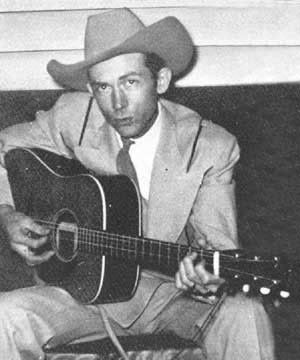
Rounding Out the Collection: Hank Williams as "Luke the Drifter"


One of my favorite things about country music is that, even as the music (and its audience) has changed drastically in the last 25 years--away from being the actual purview of the Southern working class, and towards a suburban music sung by performers as familiar with rock idioms as with "classic" country, it has become a fertile site for academic research and commentary. Country music is now a means for getting at American culture more generally. Books about Country's role in shaping/defining notions of class, it's theological implications, and as a bellweather of Southern history and the South's mainstreaming into American culture are all available (if not necessarily widely read),and the Journal of Country Music is one of the best publications available on American popular music.

So, when I decided to talk about Hank Williams' gospel-singing alter-ego, Luke the Drifter, I discovered pretty quickly there's little to say that hasn't been said. I could write at lenght about the contrast between Hank's secular work, which is some of the darkest popular music ever set to wax, and the Drifter work, which is often at least marginally uplifting (although not in the same way as most of even the most dire of country gospel--to wit:

The Monroe Brothers - What Would You Give in Exchange for Your Soul?
The Louvin Brothers - Are You Afraid to Die?
The Carter Family - No Depression in Heaven

As hard as it is to believe, the messages in these songs at least provide for some sort of eventual salvation, no matter how bad the world is--David Fillingim's Redneck Liberation makes a similar point).

I should talk about why he chose to record these track under a pseudonym (or at least a more elaborate one than "Hank," his real name being Hiram, or course). It was a commercial choice--he and his handlers were concerned that disc jockeys and jukebox operators would be less likely to play these tracks than ordinary Hank records, and they did not want to see the Hank brand's marketability affected.

I could talk to you about the parallels between Hank's own blues-influenced tales of woe, providing both reassurance and catharsis for his audience and the "secular preaching" of blues singers like Charlie Patton and Son "I'm Going to be a Baptist Preacher so I won't have to work" House (but Steve Goodson did just that in the April 1993 issue of the Alabama Review). I could even tell you about how the deeply personal nature of Hank's tales of relationship disasters presage that most golden-voiced and personal of all major country singers, George Jones--who's "Window Up Above" or "Good Year for the Roses" are the next logical step from Hank's "My Son Calls Another Man Daddy" and "You Win Again."

George Jones - Window Up Above
George Jones - Good Year for the Roses

But the Luke the Drifter material, while being an important part of the overall Williams' worldview, is not necessarily exceptional country music on its own terms (which, you should recognize, is not an argument against adding it to your collection or playing it often). In terms of both country gospel and country music more generally, it sounds to me like a step sideways--a development that dead ends with Hank. Now, obviously, these were popular enough that Hank jr. was compelled to record three albums worth of material in the early to mid-60s as "Luke the Drifter, jr.)

Hank Williams, jr. - The Dream that Woke Me Up (as Luke the Drifter, jr.) (eerie, isn't it?)

The most acclaimed of the tracks, "The Funeral," is (to my ears) maudlin and sentimental, clumsily rhymed and less incisive about the human condition than, say "Your Cheatin' Heart" and less poetic than say, "Long Gone Lonesome Blues." an honestly, late in his career he made more conventional country gospel recordings under his own name, free of both the dated racism and incomplete sense of salvation of "The Funeral"--it's more Louvin Brothers, if you will.

Hank Williams - When the Book of Life is Read

The recitation song most similar to the dire (but cathartic) work he recorded under his own name is the exceptional "Men With Broken Hearts," a cheery little ditty that fits well alongside most of his best work about relationships. Hank was the first major county star to tackle the male condition for young, poor southerners. In a society where adulthood and respectability was tied far more than it is today with being able to earn enough money and gain enough stability to marry, the plight of a sensitive man--emotionally fragile, challenged by strong women he can't have, unsure of where he can fit in such a society--it lacks the false bravado of so much later country, less the equally emotional, but far less fragile (and frankly self-pitying) cheatin' songs of, for example, Conway Twitty.

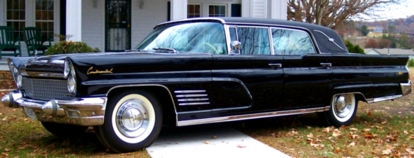
(The Car Hank was in when he died, January 1, 1953)

Hank Williams - The Funeral (Luke the Drifter)


You'll meet many just like me upon life's busy street
With shoulders stooped and heads bowed low and eyes that stare in defeat
Or souls that live within the past where sorrow plays all parts
Where a living death is all that's left for men with broken hearts
You have no right to be the judge to criticize and condemn
Just think but for the grace of God it would be you instead of him
One careless step a thoughtless deed and then the misery starts
And to those who weep death comes cheap, these men with broken hearts
("Men With Broken Hearts")

Hank Williams - Men With Broken Hearts (Luke the Drifter)

The only example of a latter-day country song by a major artist that channels the same perspective is Merle Haggard's "Carolyn," which we'll save for another day.

We also have a sardonically funny spoken word piece that's far more direct about the realities of poor white rural life than almost anything else that came before it, in "Everything's Okay." Far from the nostalgia of "My Clinch Mountain Home" or "Coat of Many Colors," Hank gives us farmer for whom the bottom has genuinely fallen out--the corn's rotting, the canned food has gone bad, and his mother-in-law has moved in to stay. But, as he thows of at the end of every new travail, "We're still a-livin', so everything's okay."

But the only reason we're getting to have this little one-way conversation is because of the fundamental wonder of the interwebs. Thanks to the "Jake and Elwood Greatest Hits' Blog," I was able to take on the entire ten disc "Complete" Hank Williams box set (which as I have come to understand is likely nowhere near complete--country music fans are apparently pretty unhappy with Mercury's treatment of the Williams catalog). The amount of Hank Williams material I had never heard, not to mention the quality of the radio transcriptions on this compilation, has kept me thoroughly busy for the last week.

---The Complete Luke the Drifter---
  1. Too Many Parties and Too Many Pals
  2. Beyond the Sunset
  3. The Funeral
  4. Everything's Okay
  5. Help Me Understand
  6. No, No Joe
  7. Just Waitin'
  8. Men With Broken Hearts
  9. Ramblin' Man
  10. Pictures From Life's Other Side
  11. I've Been Down that Road Before
  12. I Dreamed About Mama Last Night
  13. Be Careful of Stones that You Throw
  14. Please Make Up Your Mind
(make a commitment to honky tonk gospel--grab all 14 tracks here. It's also available as the CD reissue to the original Luke the Drifter compilation, Beyond the Sunset.)

Posted by Brandon

29 December 2008

They're with you, in that Long, Black Limousine...

(Elvis's own Long Black Limousine, a 1960 Lincoln Mark V)

One of the once common but now largely forgotten motifs of early 20th century American music is the journey to the graveyard, accompanying a family member/loved one on their "final" journey. The most famous of these songs is the Carter Family's "Can the Circle Be Unbroken," which Mark Zwonitzer (in his excellent Carter Family bio Will You Miss Me When I'm Gone) tells me was re-written by A.P. Carter from an old "mother's funeral" song, another common theme in British balladry and American folk and early popular music. It's a mourning song, but the message is one of praise to a welcoming God--a God who has brought mother close to His bosom, and will be bringing the singer home someday (soon, probably), as well.

Lord, I told the undertaker,
"Undertaker, please drive slow;
For this body you are hauling,
Lord, I hate to see her go"

Can the circle be unbroken,
By and by, Lord, bye and bye?
There's a better home a-waiting
In the sky, Lord, in the sky.
("Can the Circle be Unbroken")

(Of course, despite having been their biggest hit in one of their biggest years--1935--it is most widely known nowadays as the title track from the Nitty Gritty Dirt Band's 1972 album of the same name.)

Similar songs by possibly even more significant (if musically transitional) artists--Hank Williams and Elvis Presley--look, alternatively, backwards and forwards on the ballad tradition. Hank's "Six More Miles (To the Graveyard)," his own composition, followed the storyline of the graveyard trail as directly as the Carters', but the lyrics themselves are just a shadow of A.P.'s. The narrator has lost his "darling," but other than hearing the train a 'coming to carry her home, we don't get much insight into what he's going through. The song isn't, despite its title and chorus, really about the journey. It's about Hank's tenor, and the steel guitar, and the way that Hank was moving the country music tradition forward with his songwriting--deeply personal stories of love lost and vulnerability, the sort that men of an earlier moment did not sing. Notably, this song is about the loss of a lover, rather than a mother, and evokes God and religion only obliquely. It is a song exclusively about the narrator's loss, with only the faintest hint of a better home a 'waitin. Like most of Hank's best work, the loss he feels is unmitigated by the hope of salvation.

Elvis's "Long Black Limousine" started as a second-tier single on Crest Records out of Hollywood, CA--best known as an early home of pre-Rhinestone Cowboy (or even pre-Beach Boys!) Glen Campbell. It was written and performed by Vern Stovall (and Bobby George, about whom I can find absolutely nothing), who had a couple songs placed with Hank Snow and Ray Price. Eventually, Wynn Stewart picked up "Long Black Limousine," inching it stylistically towards where Elvis would end up in '68 by making it a little less archetypically honky tonkin' and making it swing in that Bakersfield way. From there it showed up on Merle Haggard's Branded Man, with a spoken-word interlude in place of a sung verse. All great songs, but none particularly revelatory in light of the Carter Family/Hank tradition.


Elvis's version, naturally, is a cosmic kick to the skull.

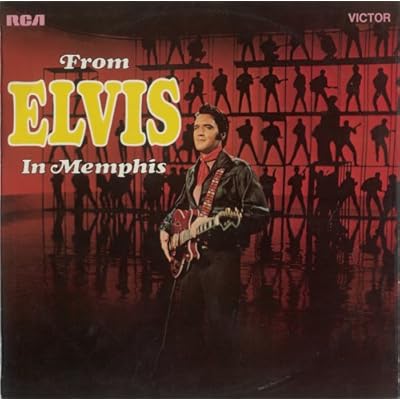
It's not just the Chips Moman production, with the fabulous but subtle backing vocals, or the American Studios session hands, some of whom had just played on Dusty in Memphis. The man had Dan Penn on guitar, for god's sake! More than anything else, it's the eeriness of listening to Elvis sing a song to an imaginary dead ex-lover--a song that sounds as if it was written for the sole purpose of being sung by some girl Elvis had bragged to about how he'd be a star (back in the Lauderdale Courts public housing development where he spent his teenage years) as she watched his funeral procession.

There's a long line of mourners, winding down through our city
Their fancy cars are such a sight to see
They must be your rich friends that knew you in the city
And now they've finally brought you back home to me
...
You said the day you left me that you would be returning
In a fancy car, for all the town to see
Well now you've finally come back, yes you've finally got your dream
Now you're riding in that long black limousine
("Long Black Limousine")

Listening to "Long Black Limousine," I can't separate Elvis the performer from Elvis the man--just another hick kid who talked big and went to the big city, but after all the high living, the traveling, the fame, and the women, ended up back where he started, having let so many down. The Memphis '68 special and the subsequent album was the last time Elvis would rise above self-parody as an artist, and this was the last great song he ever recorded.

(None of this takes into account the recently uncovered Flying Burrito Brothers live version from '69, which soulds like it's rooted in Merle's take. Since this is so widely available elsewhere, y'all can find it elsewhere.)

The Carter Family - Can the Circle Be Unbroken
Hank Williams - Six More Miles (To the Graveyard)

Vern Stovall - Long Black Limousine
Wynn Stewart - Long Black Limousine
Merle Haggard - Long Black Limousine

Elvis Presley - Long Black Limousine

Posted by Brandon

27 December 2008

Rounding Out the Collection: Richard Thompson (1988-1994), and Whoopee in Hell Mix #4


The first time I heard Richard Thompson was in January of 2000, at my friend Andre's house in Massachusetts. At the time, I was taking a month off from my Freshman year of college--our school offered a January term during the eponymous month, but I had transferred in some AP credits, and I figured the time could be better spent traveling. This was the first time I'd really traveled in the normal way on my own--I had been on lengthy camping trips with no real adult supervision, but I had never boarded a plane on my own.

Andre was a guitar-player (later, he would go on to play in a series of bands, and gigs out semi-frequently now in the Boston area with his latest project), someone who's music taste was more expansive than my own, and much more focused on musicality, as opposed to gut reaction. He liked Blood, Sweat, & Tears, Van Morrison, and Traffic--I liked the Minutemen. We had become friends over shared conversations about people we agreed on--Springsteen and Neil Young the most prominent--but despite my devoted interest in becoming a music snob, Andre was much further along. H e had a copy of Richard Thompson's 1991 album, Rumor & Sigh--an album I've grown quite fond of in the intervening years--but when he played it for me that January, it seemed tiresome and same-sounding. Later I would discover that this was because of the terrible, dated production of Mitchell Froom, who had gotten his mitts into Thompson when he had signed with Capital in the late 1980s, and had slathered a thick layer of fuzz and keyboards over the top of Thompson's exceptional guitar playing and compelling singing--a layer so thick I appreciated neither quality at the time. The only song that stuck out was called "1952 Vincent Black Lightning," where Thompson sang a ballad about a couple named James and Molly (and James's bad end) over an acoustic guitar accompaniment that was anything but bare. In fact, it was the best flat top guitar picking I'd ever heard, but having no musical knowledge, and having mostly listened to blues and punk guitar players, I didn't really appreciate how exceptional it was. Nor did I really appreciate how well the song was crafted: a wry tale of a love so true but so ill-fated, a love sealed not with a kiss, but with the gift of leather and chrome (and a boy with somewhat ridiculous priorities):

Says James "In my opinion, there's nothing in this world
Beats a '52 Vincent and a red headed girl.
Now Nortons and Indians and Greeves won't do,
Ah, they don't have a soul like a Vincent '52
Oh he reached for her hand and he slipped her the keys
Said "I've got no further use for these.
I see angels on Ariels in leather and chrome,
Swooping down from heaven to carry me home"
And he gave her one last kiss and died
And he gave her his Vincent to ride.
("1952 Vincent Black Lightning", from Rumor & Sigh)

Now this is some cornball stuff, and it smelled suspiciously like folk music--something I had every intention of staying as far away as I could from. I didn't want it tainting my Husker Du records, or mixing in with my Pixies.

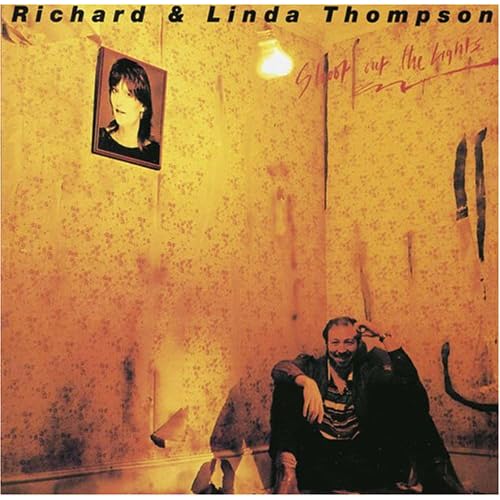
But by 2002, I had started drinking, and on certain nights, I could almost understand why Andre thought this was such an excellent song. Further drinking led me to purchase Richard Thompson's 1982 record Shoot Out the Lights, which had two things I hadn't really heard from him before--beautiful, magnificent electric guitar playing, and gorgeous vocal harmonies (between Richard and his wife/partner Linda). I learned that this was the last of a series of albums they had recorded together since 1974, along the way having become devout Sufi Muslims (Richard remains one today). Other than "1952 Vincent Black Lightning" and the depressing but humorous "God Loves a Drunk," none of my friends really caught on to Thompson:

All of my friends don't comprehend me
Their kind of style it just offends me
I want to take 'em, I want to shake 'em
'Till they pay me some heed
(from "A Man in Need," off Shoot Out the Lights)

But that's not really the point. I wanted to talk about the two records of RT's that I've finally rounded up to complete my collection. The pair of records--Amnesia (1988) and Mirror Blue (1994)--are both albums I've avoided because they don't fit my idea of a good Richard Thompson record.

The first two are from the Froom period I mentioned earlier, when crappy production combined with a rather drastic change in his style of arrangement to produce music that sounded very little like his earlier work with Linda Thompson. This period--from Amnesia to You? Me? Us? (1996) produced his most dated-sounding records. The songwriting was still, for the most part, top-notch, but the arrangements involve a lot of electric-sounding drums and layered organs and keyboards, make him sound like a folkier 'Til Tuesday.

Richard Thompson - Reckless Kind (track 3 from Amnesia)

Rumor & Sigh came out in between the two records I'm discussing here, and was a major critical and commercial success (and nominated for an Alternative Rock Grammy), which gave Froom, from the sound of Mirror Blue, some ideas. Several of the tracks feature production that sounds like it was built off a tape loop stolen from Tom Waits circa Raindogs, but rather than sounding innovative or avant-guard, it simply doesn't suit Thompson's songwriting or singing, which at this time was evolving away from his earlier electric sound and towards an aggressive acoustic approach honed during his mostly solo acoustic touring.

Richard Thompson - For the Sake of Mary (track 1 off Mirror Blue)
Richard Thompson - Mingus Eyes (track 8 off Mirror Blue)

The most successful songs on both records are the slower numbers, where the "innovative" production has the least chance to get in the way (I imagine taking Froom's name and turning it into a verb--to "Froom" meaning to take something of inherent quality and obscure it through well-meaning but misguided obfuscation. For example, "The argument in my term paper was well thought out, but I froomed it, and because she couldn't tell what I was saying, the professor gave me a C+."). In particular, Beeswing (from Mirror Blue) and "Waltzing's for Dreaming" (Amnesia) rival Thompson's best ballad work.

Richard Thompson - Waltzing's for Dreaming (track 9 from Amnesia)
Richard Thompson - Beeswing (track 10 from Mirror Blue)

Now they say love's for gamblers, oh the pendulum swings
I bet hard on love and I lost everything
So don't send me home now, put a shot in my arm
And we'll drink out old memories and we'll drink in the dawn
And Mr Bandleader won't you play one more time
For I've good folding money in this pocket of mine
(from "Waltzing's for Dreamers")

But all of this is really an elaborate segue into the minimally anticipated but lovingly prepared Whoopee in Hell Mix #4, "A Town with No Future" (A Richard Thompson Compendium). There's a pair of "Greatest Hits" packages already (one for the Richard & Linda years and one for the Capitol [read: Froom] years), but nothing career-spanning and focused on his studio recordings (there are also two multidisc comps focused on live tracks and outtakes here and here). This mix covers roughly every studio and "official" live record (including his five records as a member of the British folk/psychedelia group Fairport Convention), but rather than compile it chronologically, I went the Bob Pollard route. It's arranged as a mix, sequenced for listening, rather than posterity. And bear in mind not ever song was sung by RT--he was only rarely the lead singer in Fairport Convention, and his wife sang more than half the songs on the early records. But except for his acoustic cover of the old chestnut "Shenandoah," these are all RT compositions, and that's his lead guitar you hear on the Fairport Convention tracks, back in the day when he has making his name as one of the premier Brit guitar players not named Clapton, Page, or Beck.


Whoopee in Hell Mix #4: "A Town With no Future" - A Richard Thompson Compendium
  1. Roll Over Vaughn Williams - Richard Thompson
  2. Shoot Out The Lights - Richard & Linda Thompson
  3. Beat The Retreat - Richard & Linda Thompson
  4. Shenandoah - Richard Thompson
  5. Cooksferry Queen - Richard Thompson
  6. I Ain't Going To Drag My Feet No More - Richard Thompson
  7. Crawl Back (Under My Stone) - Richard Thompson
  8. I Want To See The Bright Lights Tonight - Richard & Linda Thompson
  9. Matty Groves - Fairport Convention
  10. Man In Need - Richard & Linda Thompson
  11. I Feel So Good - Richard Thompson
  12. Tear-Stained Letter - Richard Thompson
  13. Valerie - Richard Thompson
  14. The Angels Took My Racehorse Away - Richard Thompson
  15. Time Will Show The Wiser - Fairport Convention
  16. Don't Renege On Our Love - Richard & Linda Thompson
  17. When I Get To The Border - Richard & Linda Thompson
  18. Time To Ring Some Changes - Richard Thompson
  19. 1952 Vincent Black Lightning - Richard Thompson
  20. The Cavalry Cross - Richard & Linda Thompson
  21. Meet On The Ledge - Fairport Convention
  22. I'll Regret It All In The Morning - Richard & Linda Thompson
  23. Wall Of Death - Richard & Linda Thompson
  24. Both Ends Burning - Richard Thompson
  25. Turning of the Tide - Richard Thompson
  26. I Can't Wake Up To Save My Life - Richard Thompson
  27. Sibella - Richard Thompson
  28. Don't Sit On My Jimmy Shands - Richard Thompson
  29. Dark End Of The Street [Live] - Richard & Linda Thompson
  30. I Want To See The Bright Lights Tonight [Live] - Richard Thompson
  31. God Loves A Drunk - Richard Thompson
  32. Dad's Gonna Kill Me - Richard Thompson
Get Tracks 1-14; 15-32

Posted by Brandon

21 December 2008

Whoopee in Hell Mix #3: Baby Jesus, Born to Rock! (and Getting to Phoenix...)


The desktop widget that updates me on the weather says it's -8° right outside my window. I was outside once today, to help my wife scrape her windshield and make sure her car started (it did, thank god). It's one of those days--the 25 mph winds, the bitter cold--when they would have canceled school when I was younger. Of course, it's not a school day, and in any case, my school year is over.

So, as you've noticed, we've had our first post from my good friend and fellow contributor. We'll do a post about us in a little while. But the proximate result of his first post is that we're happy to present you with dueling Christmas Mixes this holiday season.

Unlike my colleague, I've mellowed rather a lot over the years, and
can almost look you all in the eye and say I like Christmas. And I do--especially the cold, white aspect of it. I've lived in the Upper Midwest most of my life, and what I missed most last Christmas, sitting on the knife edge of the quickly approaching Sahara Desert in Nigeria, was the snow and cold. Obviously, apartment living helps--I haven't shoveled a meaningful amount of snow in three years.

But you're hear for the music. Instead of Compton's weakest link, we begin on this side with the Rev. A. W. Nix, who has a depression-era message of Christmas warmth--the kind that you feel deep down up in your bones from sidling up next to Satan! So having gotten our priorities and our souls right with God, we're able to get down to our sexy, funky business. While I love a great pop song more than the next guy ("Baby Jesus, born to rock!" is E's Christmas manifesto on track two), I spend half my time on rowdy soul and rockabilly--my highlights are Sonny Boy
Williamson II's message of Christmas materialism (blues singers almost inevitably call St. Nick "Santy Claus," which is fine by us), and of course Clarence Carter's loverman "Backdoor Santa," who looks ridiculous but still cuckolds you Christmas morning--"he don't come but once a year," if you get his drift.

Also, some of you may recognize the lead singer of Adam's House Cat as the Drive-By Truckers' Patterson Hood. He and guitar hero Mike Cooley were singing about smack-addled Santas long before writing
the "Southern Rock Opera." And, since I have a natural need for one-upmanship, if the first mix brought you "Christmas in Vietnam," on this mix the Black Lips will give you "Christmas in Baghdad," crackly from the 7 inch vinyl. And we end, naturally, with some spoken-word recollections my Mr. Johnny Cash, from his 1963 Columbia album, "The Christmas Spirit":
Christmas came, and Christmas went,
Christmas that year was heaven-sent.

And my daddy put on his rubber boots
and faced the floor, waitin' for the thaw,
back home in Dyess, ArkansasJohnny Cash's childhood home (Dyess, Arkansas, circa 2007)

Whoopee in Hell Mix #3: Baby Jesus, Born to Rock!
  1. How Will You Spend Christmas - Rev. A.W. Nix
  2. Everything's Gonna Be Cool This Christmas - Eels
  3. Christmas With the Devil - Spinal Tap
  4. There ain't no Santa Claus on the Evenin' Stage - Captain Beefheart
  5. Christmas Feeling Ska - Toots & the Maytals
  6. Poor Mr. Santa - Andre Williams
  7. Santa Claus - Sonny Boy Williamson
  8. Backdoor Santa - Clarence Carter
  9. Santa Claus Wants Some Lovin' - Albert King
  10. Christmas Celebration - B.B. King
  11. This Christmas - Donny Hathaway
  12. I Hear Jingle Bells - Freddie King
  13. Who Took The Merry Out Of Christmas - The Staple Singers
  14. Listening To Otis Redding At Home on Christmas Day - Okkervil River
  15. Christmas Card From A Hooker In Minneapolis - Neko Case
  16. Grateful for Christmas - Hayes Carll
  17. Merry Christmas from the Family - Robert Earl Keen
  18. Too Much Wine - The Handsome Family
  19. Christmas is for Losers - Mike Nicolai
  20. Here It Is Christmas - The Old 97's
  21. Jesus Christ - Big Star
  22. The Christmas Song - Weezer
  23. Sometimes You Have To Work On Christmas - Harvey Danger
  24. Santa Claus - Wild Billy Childish & The Musicians of the British Empire
  25. Christmas In Baghdad - Black Lips
  26. Christmas Lullaby - Cary Grant
  27. Santa's Out of Rehab by Christmas - Adam's House Cat
  28. Merry Christmas Baby - The BellRays
  29. Jingle Bells (Dan The Automator Remix) - Dean Martin
  30. Millie Pulled A Pistol On Santa - De La Soul
  31. My Christmas Bells - Hard Call Christmas (Peanut Butter Wolf)
  32. Jingle Bells - Ice-T
  33. Santa Claus is Sometimes Brown - El Vez
  34. Please Come Home For Christmas - Charles Brown
  35. Santa Claus' Daughter - Charlie Rich
  36. They Shined Up Rudolph's Nose - Johnny Horton
  37. Lonesome Christmas (Part 1) - Lowell Fulson
  38. Silent Night - Tom Waits
  39. Christmas As I Knew It - Johnny Cash
Get it in two parts (Part one, tracks 1-18) (Part two, tracks 19-39).

And as an aside, you'll notice that this mix is labeled #3. That's not a mistake. Whoopee in Hell mix #2 is lost in cyberspace, just as its author (and my buddy and co-contributor) is lost in Arizona. Coming from Illinois to Idaho this morning, his plane was late in Chicago, and having missed his connection, he's stuck in Phoenix, waiting for a plane. He's told me he may be stuck until Christmas morning, his mix sadly unposted. So until we get to see your take on Christmas music, brother, this is for you. Keep the faith.

Glen Campbell - By the Time I Get to Phoenix
Wanda Jackson - By the Time You Got to Phoenix
(the thunderclap of misery that is) Isaac Hayes - By the Time I Get to Phoenix

And, last but not least...

Centro-Matic - Keep the Phoenix in Slow Motion
Public Enemy - By the Time I Get to Arizona

Safe travels, good people. Leave and travel well.

Posted by Brandon


20 December 2008

I'm Sitting Here Wondering, Would a Matchbox Hold my Clothes?


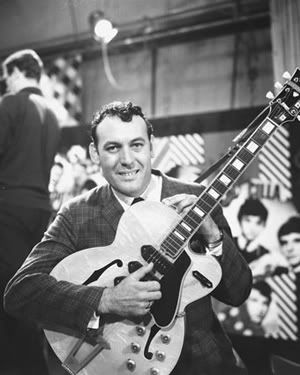
I've been on a bit of a Carl Perkins kick the last few months. I mention this now because 'tis the season on music blogs across the interwebs to write one (or both) of the two classic end-of-year posts: the "year in review" best albums/single post, and the Chrismas post. We'll be doing a Christmas post or two, but I'm not prepared to sum up the year in music. There are several reasons for this.

First, I was overseas until the middle of July, which provides me with a pretty ironclad alibi for having missed Bon Iver the first time around (the fact that I'm from Wiscconsin may make this less excusable, but I'll live with it). I was in Nigeria, actually--not a land of Bit Torrents and Mom and Pop record shops, and other than a copy of Sprinsteen's "Magic" that arrived around Christmastime, I had only what I could carry on my 80GB Ipod to keep me company. Now, obviously, this is a lot of music, but I wasn't exactly plugged into Fleet Foxes. I had my catalogue records--a lot of older music I wanted to catch up on.

So that's the good reason. The second reason is the one I have more trepidation about. To preface: I was an early adopter of the current indie music scene. Pitchfork has been my homepage since 2002. I bought Broken Social Scene's "You Forget it in People" when it first came out in the US--the first copy off the truck here in Madison. But lately, I've been disillusioned by the whole thing--tired of the scramble to keep up. I like to tell myself it coincided with the rise of freak-folk and the whole Firey Furnaces/Animal Collective thing--that I was more of what Robert Christgau calls a "poppist" than an experimental/avant-garde fan (which is clearly one way to look at it).

But that's not really the issue. The issue is that I just don't care as much as I used to. I'd like to pretend it has to do with my creeping disdain for hipster culture--I'm not nearly skinny enough to pull off the new tight pants look, and too far out of shape for a fixed gear bike (I ride a 15 year old Schwinn mountain bike with a duct taped seat). But that's not it, either. I really just don't care anymore.

The biggest single factor is probably being out of college. While I love my graduate work, my taste in music doesn't really make much of a difference to the people I spend most of my days with. None of my fellow graduate students really want to discuss the merits of the new Deerhunter record(s), or discuss the ramifications of the Handsome Dick Manitoba lawsuit that resulted in Dan Smith's band becoming Caribou (not even the law and politics people!). I could probably interest at least one person in Ghostface Killah gossip, but I couldn't drum up interest in the Cool Kids. The music I listen to just doesn't really define me socially anymore--and all that work I used to do keeping up just doesn't seem valuable anymore. That and my wife sometimes expects me to "pay attention" to her.

So that brings me back to Carl Perkins. The last couple of years, I've been a lot more serious about Country/Soul/Blues/Rockabilly (the whole paying attention to my wife thing kinda went out the window with the faster high-speed internet). While my explorations in those regards are the subjects of once and future posts, I do find myself much more strongly drawn to older records. It's not like this stuff was (for the most part) part of my childhood--and it's not like I buy into the whole "authenicity" problematic. And I own at least 14 different t-shirts. And lots of underwear. So it's not like this song appeals to me literally. But yet I love it.

And even more, I love this version, which when I first saw it, helped to rekindle my interest in Derek & the Dominoes:


And of course, there's the original (near as I know):

And finally, for good measure, the finest rockabilly song ever:

and the hard-to-get but fantastic cover by the Memphis legend, Big Star-producing, North Mississippi All-Stars-siring James Luther Dickinson:

James Luther Dickinson - Dixie Fried (oh, hell. Want the whole album? Here it is.)

Thanks, y'all.

Posted by Brandon

17 December 2008

If we make it through December...


Here at the mighty University of Wisconsin, it's finals time, and for the lowly graduate teaching assistants of the world, this means two things:
1) Grading
and
2) Reduced Blogging.
I have about 120 blue book essays to grade by Friday morning, which means I'm rather unlikely to post between now and then. After that, the semester is over, and you all can expect a lot more posting (our second contributor also expects to come online in the next week or two, so be on the lookout).