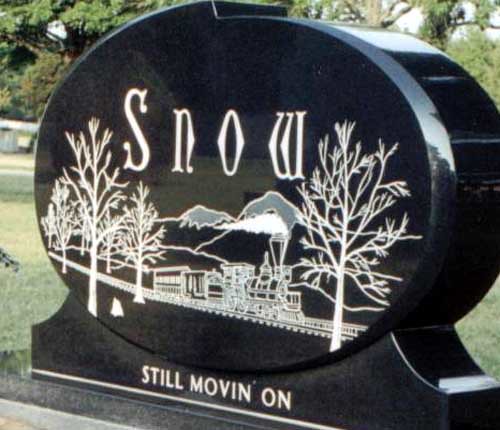
Hank Snow, another of the Nudie Suit-wearing, honky tonkin' stars of early post-war country music is, for Peter Guralnick, a pair with Ernest Tubb. Both were profoundly shaped by their early exposure to Jimmie Rodgers, and worked to maintain his legacy (most notably at the Jimmie Rodgers Country Music Festival, annually in his hometown of Meridian, Mississippi). Both served long apprenticeships prior to "making it" in mainstream country, including unsuccessful stints in Hollywood trying to fit the Gene Autry mold. Both encapsulated the "Golden age" country sound, a sound that was the face of American popular music for an enormous share of the nation between 1940 and 1956, and both (but especially Hank) helped to sponsor and usher in the music that would eventually surpass their own in popularity in Tennessee and far, far beyond.
Hank Snow's story is nonetheless a unique one--the first Canadian to become a star in a most American style of music. His youth in Nova Scotia, to parents whose economic lives weren't all that dissimilar to the lives of most poor whites in the American South. His abusive step-father and hard economic times sent him to sea as a cabin boy in his early teens, but that couldn't stop him form having that same epiphany young Ernest Tubb did, when at age 16, he heard Jimmie Rodgers for the first time. But years of struggles, as a DJ and singer on Canadian radio, barnstorming, and finally (with the better-established Tubb's help), a gig at the Grand Ole Opry, one that turned into a 40+ year permanent gig.
Hank Snow on Jimmie Rodgers' influence on his own songwriting
Ultimately, aside from his own iconic status, he's here for two reasons--his role in helping to get a 19 year old Elvis the Opry gig that helped to launch his career, and as proof of the both the influence of his kind of country music had on such a large cross section of the U.S., and his continued support of the country mainstream in the face of its erosion in the 70s. Like Tubb, he continued to appear regularly on the Opry well after the biggest stars no longer appeared regularly. And his singles, like Tubb's were, as Guralnick puts it on page 46, the music "that marked a whole generation's passing into musical maturity." Guralanick's project with Snow reminds me of my own efforts to convince myself of how good the Rolling Stones really were as a teenager. When I bought Hot Rocks, I was unconvinced--"Satisfaction" and all the rest were on my Dad's oldies channel, and they sounded played-out to me. I couldn't hear them with open ears. It took Exile on Main Street, packed full of songs I'd never heard out of tinny clock radio speakers, to convince me how good they really were. Hank Snow's influence is, as Guralnick argues, hard for a post-Elvis generation to appreciate, but it is, as I noted with Tubb, what my grandparents would have recognized as archetypal country music (He also had a keen ear for the novelty song, as tracks like the "Rhumba Boogie" bear out).For those looking for direct lines of influence, check out part 13 of an ongoing series of posts over at another Whoopee in Hell favorite, "Any Major Dude With Half a Heart" (yes, that's a Steely Dan reference, but don't be frightened off, good people, it's an excellent blog) looking at original versions of famous songs. Your curiosity will be rewarded with a Hank Snow song that became a big (US #2) hit for Elvis in 1959.
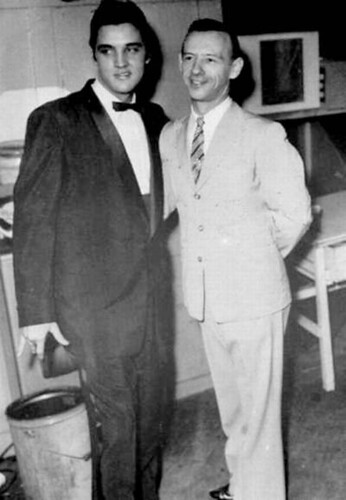
Hank with Elvis (circa 1956). Note the sneer and the tux.
As with Tubb, in this chapter Guralnick's interest is with Snow's first big recordings, rather than on the 1950s singles like "I've Been Everywhere," "Miller's Cave," and "The Golden Rocket" that are the "Singing Ranger's" (because, of course, he's Canadian) best legacy. He's a man few people alive remember as a young performer--he lingered on for such a long time that he's remembered more for his golden years on the Opry (the reference to him in Smokey and the Bandit, e.g.) than for his early hit-making. But here's those early hits, nonetheless.
My wife is from Fort Worth, Texas--a city of great country music tradition and heritage, the long time home base of Bob Wills and the Light Crust Doughboys (singers of the immortal "Pussy, Pussy, Pussy," still the best double entendre record ever released by a country act, Brad Paisley's "Ticks" included)--
and for a while the base of the most important of country music's third wave singers, Ernest Tubb. Naturally, it took meeting me for my wife to learn of any of this. One of her favorite stories is about my second trip home to see her family. I asked very politely to be taken to Fort Worth's main tourist quarter, the "Stockyards." an area of town I had not been shown on my first trip, apparently because my mother-in-law is not fond of it. As the proud owner of a variety of western shirts (I was married in this one):
(several of which were, graciously, presents from said mother-in-law, who has become aquainted with my predilections), I was excited by the prospect of a few hours of cowboy culture. Most importantly, though, I had my eyes on the Mecca of honky tonk, the Fort Worth branch of Ernest Tubb's record shop. My wife and mother-in-law dropping me off there for an hour so they could peruse something a little less "down home," I went a little "hillbilly nuts," if you'll excuse the BR5-49 reference, eventually purchasing 12 CDs for the low, low price of $150 dollars. Hearing of this, my mother-in-law was flabbergasted. It genuinely amazed her, not just that anyone could spend so much on records, but more, that any kid from Wisconsin (let alone one engaged to her daughter) could be so taken by the corniest, most obviously tourist part of her adoptive hometown--a part of town she herself had little business with. My in-laws have always looked at me a little cockeyed since.
But this isn't about Ernest Tubb's Record Shop (although the Memphis branch, which was the site of the Grand Ole Opry afterparty for many years, figures in the chapter), it's about the man himself. The first one of Guralnick's five "Honky-Tonk" heroes (only three of whom played anything approaching country music) which presaged the rockabilly culture and music that seems to be his first and strongest love in this book, Ernest Tubb's story is one of the first generation of country musicians to mature as the genre itself was becoming respectable. His personal hero Jimmie Rodgers was not the first "hillbilly" singer to record, but he succeeded (unintentionally) in codifying many of the memes that would standardize themselves in a generation, and in doing so pushing out the "Weird, Old America" semi-pros (Dock Boggs), contemporary anachronisms (Blind Alfred Reed), and reformed opera singers (Vernon Dalhart) from the genre, paving the way for the real professionals. The ten years between Rodgers and Tubb, what I'll call the "Second generation" for clarity's sake, were men like Roy Acuff, staunch traditionalists who retained the image of down home amateurism while becoming far more commercially savvy, with original, professional songs and musicians (in fact, Jimmie Rodgers' sister-in-law, a professional songwriter, wrote some material for Tubb at Rodgers' widow's request).
In the Guralnick narrative (Which I've expanded, obviously), Ernest Tubb is the fully professional, flour-schilling, radio-recording, barnstorming (and drum set using) link between the real traditional music and the revolution of Hank Williams (which was, of course, not really a revolution at all and soon gave way to the more radical reformulations of Elvis). His path to stardom was inexorably linked with the height of the Opry's influence on American life, and his relentless touring and recording well into the 1970s were an effort to retain the vitality of country music's height of cultural influence, even as country music (and society) changed radically, and MCA studio studio execs dropped the 61 year old from their roster.
Tubb is, in essence, what my grandparents (of the age to have served in WWII) would have known as country music, a music halfway in between its rural roots and something more, an incomplete creole of black and white, rural and urban, at the height of its influence but on the cusp of something more. The songs from the chapter emphasize Tubb's earliest hits, especially the enormously influential "Walking the Floor Over You" over his 50's material (because by then, in Guralnick's storyline, Tubb isn't really the story anymore).He was (at the writing of this piece in the mid-70s) interesting as a performer in his own right and as a link to the past, but Tubb and the four singers who'll follow in this section are here to prime us for what comes next--rockabilly, outlaw country, and in the end, a return to the blues.
Ernest Tubb - There's a Little Bit of Everything in Texas
Oh, and bear in mind, as I hit the end of each section in the book, I'll throw all the tracks together in a .zip file for easy downloading. If the downloads don't work, it's because we've run out of bandwidth temporarily. Just come back the next day, or wait for the .zip. Thanks, y'all.
Of course, all songs provided here are for sampling/illustrative purposes only (which we believe to constitute fair use). Do try to support your local independent music retailer (especially if they love to do special-orders, god bless 'em), and contact us at whoopeeinhell@gmail.com if you are an artist or label and would like your music removed (don't be snarky and go straight to Blogger--we'll happily take it down!). Word.
Oh, and holler at your boys: whoopeeinhell[at]gmail.com

 Hank Snow, another of the Nudie Suit-wearing, honky tonkin' stars of early post-war country music is, for Peter Guralnick, a pair with Ernest Tubb. Both were profoundly shaped by their early exposure to Jimmie Rodgers, and worked to maintain his legacy (most notably at the Jimmie Rodgers Country Music Festival, annually in his hometown of Meridian, Mississippi). Both served long apprenticeships prior to "making it" in mainstream country, including unsuccessful stints in Hollywood trying to fit the Gene Autry mold. Both encapsulated the "Golden age" country sound, a sound that was the face of American popular music for an enormous share of the nation between 1940 and 1956, and both (but especially Hank) helped to sponsor and usher in the music that would eventually surpass their own in popularity in Tennessee and far, far beyond.
 Hank with Elvis (circa 1956). Note the sneer and the tux.



 Posts
Posts

